


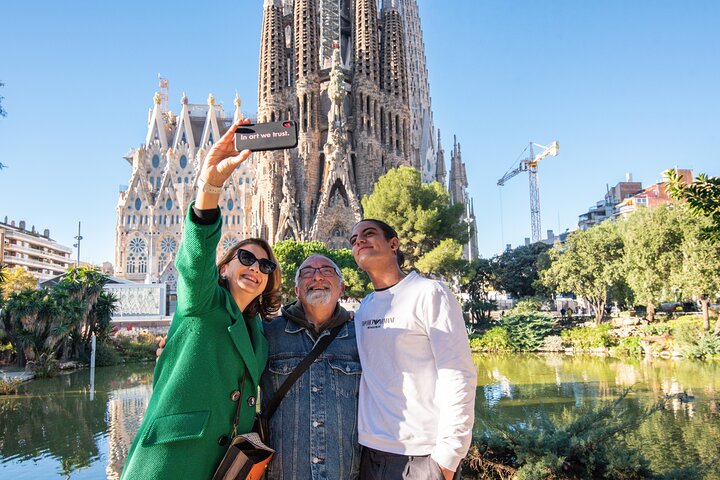


Understanding Gaudí’s Unfinished Masterpiece
The Basílica de la Sagrada Família is Antoni Gaudí’s life work — a Roman Catholic basilica that has been under construction since 1882 and is projected for completion in approximately 2026 (the centenary of Gaudí’s death). The building is a UNESCO World Heritage Site, Barcelona’s most visited attraction (approximately 4.5 million visitors annually), and the most ambitious religious building project undertaken in the modern era. A guided tour provides the architectural, religious, and biographical narration that transforms the visit from an encounter with a spectacular but bewildering building into a comprehensible engagement with one of the most extraordinary creative achievements of the last 200 years.
What the Guide Explains
The facades — the Sagrada Família has three monumental facades, each telling a different chapter of Christ’s life. The Nativity Facade (the only facade substantially completed during Gaudí’s lifetime, on the northeast side) depicts the birth and early life of Christ in an explosion of naturalistic sculpture — animals, plants, angels, musicians, and the Holy Family emerge from the stone in organic, almost hallucinatory profusion. The Passion Facade (on the southwest side, designed by sculptor Josep Maria Subirachs from the 1980s onward) depicts Christ’s suffering and crucifixion in stark, angular, controversial forms — deliberately austere and confrontational, a dramatic contrast to the Nativity Facade’s warmth. The Glory Facade (the main entrance, still under construction) will depict humanity’s journey from death through the Last Judgment to divine glory — the theological climax of the building.
The interior is where the Sagrada Família departs from every other church in history. The columns branch like trees — Gaudí designed them as hyperbolic structures that split into branches at their tops, supporting the vaulted ceiling like a stone forest canopy. The light enters through stained-glass windows that progress from warm colours (oranges, reds, yellows — the sunrise side, the Nativity Facade) to cool colours (blues, greens, purples — the sunset side, the Passion Facade), and the interior light shifts throughout the day as the sun moves — the building is designed to be experienced differently at every hour. The ceiling’s hyperboloid surfaces scatter and reflect the light in ways that are unlike any Gothic cathedral or any modern church — the effect is simultaneously natural (the forest-canopy metaphor is immediately legible) and otherworldly.
The geometry — Gaudí abandoned the Gothic pointed arch and the classical column in favour of mathematical forms derived from nature: hyperbolic paraboloids, hyperboloids of revolution, helicoids, and catenary arches (the shape a chain makes when it hangs freely — Gaudí inverted it to create the perfect structural arch). These forms are structurally optimal (they distribute loads without the flying buttresses that Gothic cathedrals require) and visually organic (they look like they grew rather than were built). A guide identifies the specific geometric forms in the columns, the ceiling, the windows, and the towers — the mathematical vocabulary that makes the building both structurally innovative and visually unprecedented.
Gaudí’s death — on 7 June 1926, Gaudí was struck by a tram near the Gran Via de les Corts Catalanes. He was mistaken for a beggar (he had become increasingly ascetic in his later years, living in his workshop at the Sagrada Família, wearing threadbare clothes) and was taken to a public hospital where he died three days later, on 10 June. He is buried in the crypt of the Sagrada Família, beneath the building he spent the last 43 years of his life designing. The guide narrates this story at the crypt — the conclusion of both the tour and Gaudí’s biography.
Practical Details
A guided tour takes approximately 1.5–2 hours covering the exterior facades (the Nativity and Passion), the interior (the forest columns, the light, the geometry), the crypt (Gaudí’s tomb), and — on tours with tower access — the ascent to one of the towers for the city panorama.
The interior is the priority. The exterior facades are impressive from the street, but the interior — the light, the columns, the ceiling — is the experience that distinguishes the Sagrada Família from every other building on earth. A guide directs your attention upward (to the branching columns and the ceiling vaults), laterally (to the stained-glass colour progression), and downward (to the crypt) in a sequence that makes the building’s logic visible.
Frequently Asked Questions
How long is a guided Sagrada Família tour?
Approximately 1.5–2 hours. Tours with tower access add approximately 30–45 minutes (the lift ascent and the spiral staircase descent).
Is a guided tour necessary, or can I visit independently?
The Sagrada Família is architecturally and symbolically dense — every surface, every column, every window has a specific function in Gaudí’s theological and structural programme. Without a guide (or at minimum the audio guide), you see a spectacular building but miss the logic. With a guide, you understand why every element exists and how the parts relate to the whole. The guided tour is the strongly recommended format.
Do I need to book in advance?
Yes — the Sagrada Família operates on timed-entry tickets and popular time slots sell out days or weeks ahead. Booking online in advance is essential, particularly in summer (June–September).
When is the best time to visit?
Late morning (10:00–11:00 AM) for the warm light through the Nativity Facade windows (oranges and reds). Late afternoon (4:00–5:00 PM) for the cool light through the Passion Facade windows (blues and greens). The interior light changes throughout the day — the guide times the visit to the most atmospheric window.